Master Thesis
My master thesis, starting with the abstract
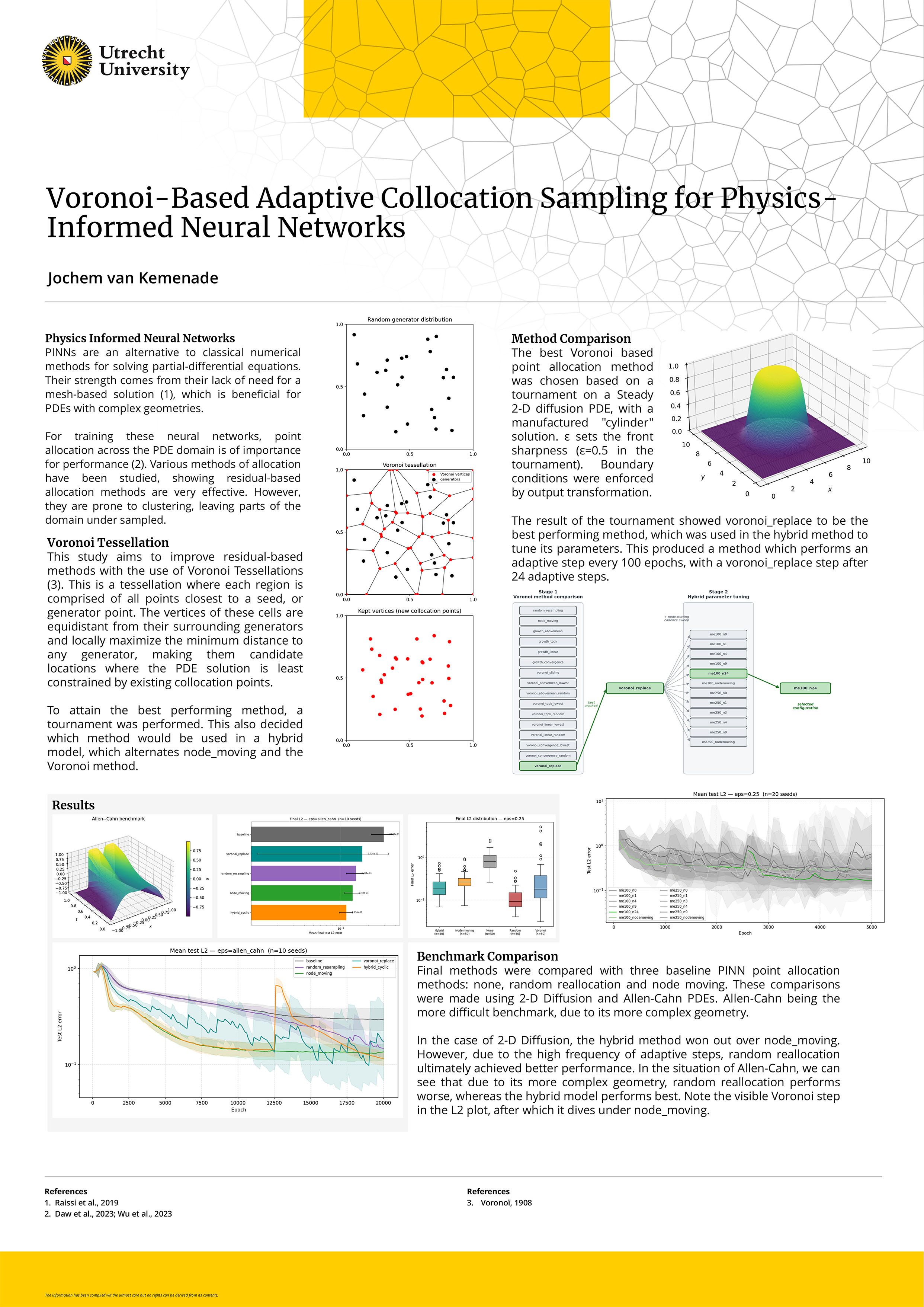
Voronoi-Based Adaptive Collocation Sampling for Physics-Informed Neural Networks
Abstract
Physics-Informed Neural Networks (PINNs) are sensitive to the distribution of interior collocation points, and residual-driven adaptive methods can cause points to cluster, leaving parts of the domain under-sampled. This thesis proposes two Voronoi-based collocation strategies: a standalone replacement method and a hybrid that alternates node moving with periodic Voronoi reseeding. Both are evaluated on a cylinder benchmark and the Allen-Cahn equation against static, random, and node-moving baselines. The standalone method is inconsistent across problem difficulty. The hybrid matches node moving on smooth surfaces and significantly outperforms it on steeper ones, suggesting that Voronoi tessellation is effective as a periodic corrective step within a residual-driven framework.
My Experience
Starting the thesis, I was daunted by the complex subject. I'm very interested in physics, but my experiences so far had been limited to watching engineering, explainer and random fact videos. Diving into arguably the most complex part (partial differential equations) with no formal high-level maths education was kind of scary!
The first few weeks were spent looking through the already existing support library for training the PINNs, and reading research on the subject. During this research I found myself with the somewhat relieving realisation that I would not need to complete an entire bachelors' in maths and engineering in three weeks. The core of the research was about point distribution methods on a plane, which I could understand and experiment on. I was still lacking a good intuitive sense for the interactions which occur between training point location and predicted PDE surface results. This would come eventually though. During this first period the main challenge was thinking of a research question which was well enough defined to be tested in an experimental setup. This is where I would have to rely on my supervisors. With them being experienced in the field, they recommended researching implementations for a voronoi tesselation for use in point allocation.
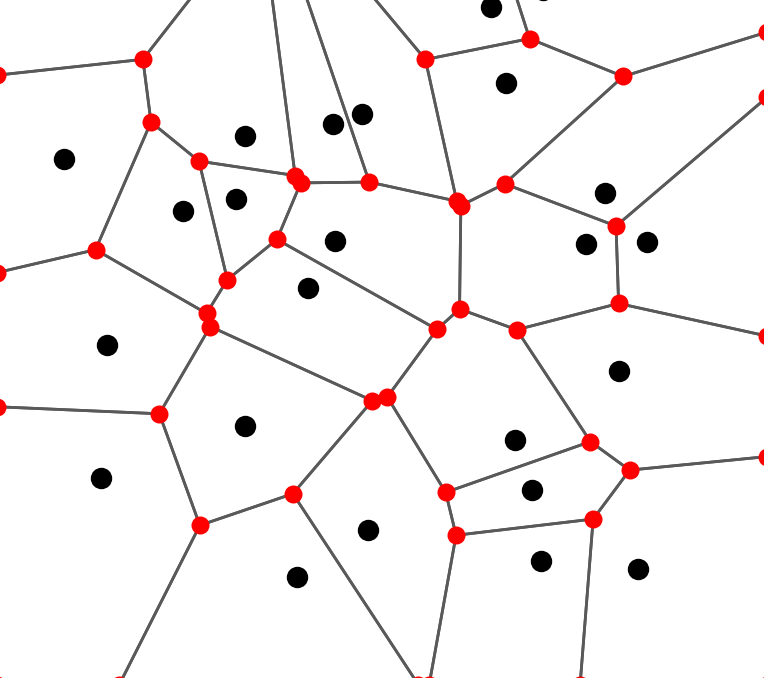
Me being a big fan of visualisations loved this idea. A voronoi tesselation is visually striking and intuitive to grasp. The rest of the research quickly followed, ultimately ending in a large tournament style comparison between all voronoi implementations I could think of, whilst maintaining fair comparison. The poster I've made for the thesis defence itself is displayed below.